



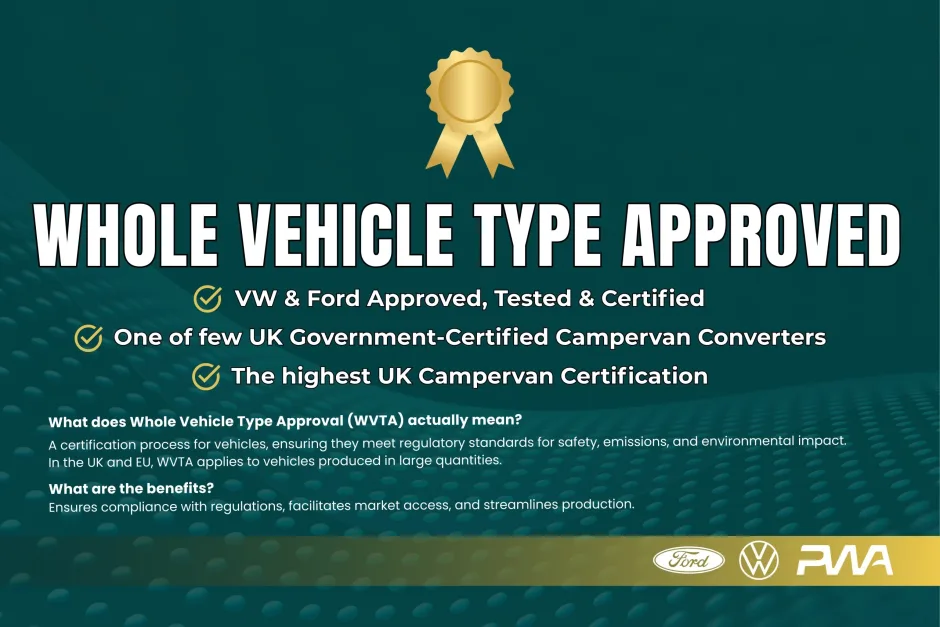
Whole Vehicle Type Approval (WVTA) is a vital certification process that ensures vehicles meet stringent safety, environmental, and production quality standards before entering the market.
It’s a comprehensive system designed to protect consumers and uphold industry-wide standards, while allowing manufacturers to streamline production and market access.
This is perhaps even more important when shopping around for leisure vehicles like campervans, as it ensures that any conversion work has been carried out in line with regulatory requirements. In short, it means that your van is safe and ready for your next adventure. We hold GB type approval for the Ford Transit Custom and VW Transporter.
In this post we’ll explore:
- What is Whole Vehicle Type Approval (WVTA)
- The Core Pillars of Whole Vehicle Type Approval (WVTA)
- The Benefits of Whole Vehicle Type Approval
- Investing in Peace of Mind with Platinum Wave Automotive
- Whole Vehicle Type Approval Frequently Asked Questions
What is Whole Vehicle Type Approval (WVTA)
Type approval certifies that a vehicle or its components comply with regulatory requirements. It serves as a mark of quality and safety, demonstrating that the manufacturer adheres to specified technical standards and production practices.
The certification process applies to various elements, including individual parts, systems, and the whole vehicle, ensuring every aspect meets rigorous criteria. The process of securing GB whole vehicle type approval is comprehensive, stringent and requires ongoing participation from manufacturers. It’s not a certificate that we can secure once and then forget about.
Securing Vehicle Type Approval
To secure whole vehicle type approval, we have to first gain a letter of association from the original equipment manufacturer. Our processes and facilities are then audited by the Vehicle Certification Agency (VCA), which includes an onsite audit and review of our processes from purchasing to PDI. Key tools are sent off quarterly for external calibration and all processes are reviewed every 3 months to ensure standards never slip.
Once the audit stage is completed, we then have to submit a vehicle for type approval to ensure we’re adhering to all requirements of the scheme. This process covers everything from our documentation, to all of the components we have used for the campervan conversion, including leisure components like seats, swivels, beds and fridges.
The 2026 Shift: Moving from Provisional to Full GB Type Approval
The GB type approval scheme has been phased in over the last few years in response to regulatory changes in the wake of Brexit. From 2021, the VCA would issue GB approvals if the manufacturer could demonstrate that EU whole vehicle type approval was in place. This was known as the provisional type approval scheme, which paved the way for a more robust GB scheme.
By February 2026, all provisional type approvals expired and manufacturers were expected to be ready for full GB approval. We’re proud to hold GB type approval for the Ford Transit Custom and VW Transporter, two of the most popular choices for campervan conversions for both business and leisure.
The Core Pillars of Whole Vehicle Type Approval (WVTA)
Safety is at the core of WVTA. It requires manufacturers to demonstrate that their vehicles and processes meet established safety standards. This applies to vehicles when they enter the market, and also those that have been converted for specific purposes, including campervans.
Conformity of Production (CoP): Consistency You Can Trust
A key part of whole vehicle type approval is the concept of conformity of production, which verifies that manufacturers have the correct processes in place to be able to achieve conformity.
This ensures consistent quality across production runs. Manufacturers must have robust systems to guarantee repeatability, traceability, and adherence to the approved prototype’s standards.
Pull-Testing and Structural Integrity: Beyond the Visual Check
When you get into a vehicle, you assume that the safety features included are there to keep you safe and won’t be at risk of causing harm. With converted vehicles, there is always the risk that new seatbelts haven’t been installed correctly, putting passengers at risk.
We go beyond visual checks to ensure that all components are fit for purpose. A key pillar of whole vehicle type approval rests on this rigorous testing of both parts and whole vehicles to ensure compliance with the required regulations. These tests cover everything, including safety performance, emissions, and durability.
We complete a 30+ point check of all things related to type approval to ensure each vehicle has been built using the correct processes, with the correct parts, by sufficiently trained staff. This is far more in-depth than the PDI process that takes place afterwards, and allows us to enjoy peace of mind that the vehicle has been converted correctly.
Competency of Technicians
Skilled and qualified technicians play a pivotal role in maintaining safety and quality during production. What good is certification and auditing if the day-to-day operations are not up to standard?
All staff are trained to follow these regularly reviewed processes, which means we can ensure the quality of craftsmanship remains consistently high.
The Tools We Use
Key tools are sent off quarterly for external calibration to ensure that when used we are working with full traceability on critical safety related processes such as seat to chassis bolt torques. This ensures that the highest safety standards are followed when converting our vehicles giving peace of mind to you that it’s been done right.
Component Certification: The Danger of Aftermarket “Shortcuts”
Every component used in the vehicle must undergo thorough testing and certification. This ensures that each part performs reliably and integrates safely within the vehicle, meeting necessary performance and environmental standards.
We only fit approved and fully tested items. A good one to discuss would be seats/beds as this requires 3 regulations (UNECE R14, 16 & 17) to be included into the GB type approval.
For further peace of mind, vehicles must carry proper identification, such as the Vehicle Identification Number (VIN), and be accompanied by comprehensive documentation. This ensures traceability and facilitates registration in different markets.
The Benefits of Whole Vehicle Type Approval
Both consumers and manufacturers benefit from whole vehicle type approval. By enforcing stringent safety standards, WVTA protects consumers from substandard or unsafe vehicles, ensuring peace of mind for buyers and users.
Standardised approval processes reduce complexity, allowing manufacturers to streamline production and achieve cost efficiencies without compromising quality. Rather than test each and every vehicle, they monitor and document the components and processes they are using, ensuring enhanced safety.
Why Whole Vehicle Type Approval Matters
Whole Vehicle Type Approval is not just a regulatory requirement; it’s a commitment to quality, safety, and environmental responsibility. By adhering to these standards, manufacturers ensure that their vehicles meet the expectations of both regulators and consumers, paving the way for safer roads and a more sustainable automotive industry.
With a converted vehicle like a campervan, you want to feel confident that no part of the build is substandard.
Investing in Peace of Mind with Platinum Wave Automotive
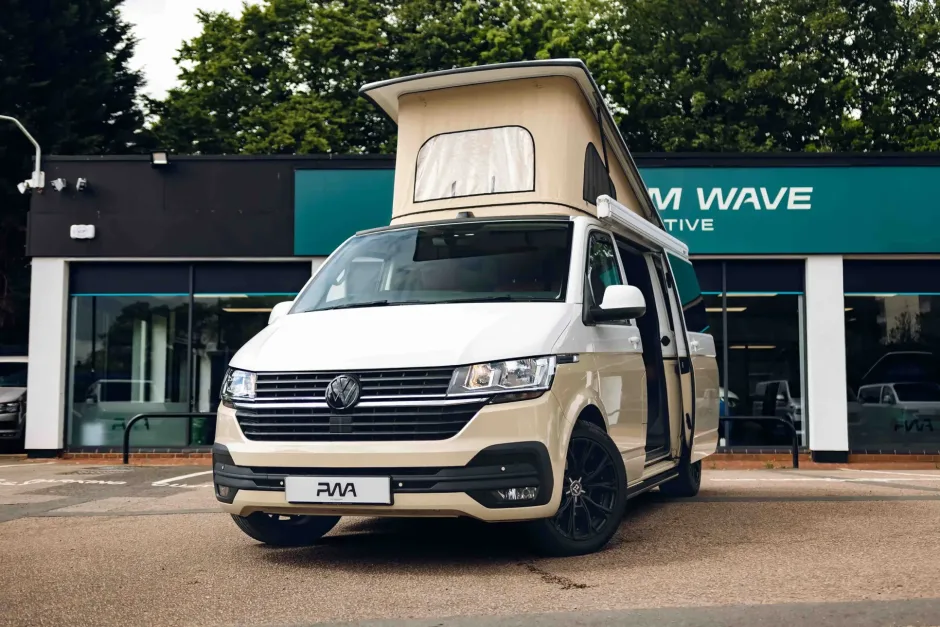
When it comes to purchasing a campervan, safety should never be compromised. By choosing Platinum Wave Automotive for your new camper, you’re investing in more than just adventure, you’re prioritising peace of mind. Our Ford Transit Custom vans are GB Whole Vehicle Type Approved, meaning they meet the highest safety and quality standards. We’re also working to ensure our VW T6.1 campervans are also GB Whole Vehicle Type Approved.
It’s important to note that not all parts used by other manufacturers or aftermarket components are type approved. This is why, at Platinum Wave Automotive, we sometimes cannot fit certain items if they fall outside the scope of our type approval.
This isn’t a limitation, it’s a commitment to your safety. By adhering strictly to approved components and processes, we ensure that every campervan we deliver offers reliability, quality, and compliance with the highest standards.
With us, you can hit the road with confidence, knowing that your vehicle is as safe as it is luxurious.
Whole Vehicle Type Approval Frequently Asked Questions
Is WVTA mandatory for all campervan conversions?
No, this isn’t essential for all DIY or hobby conversions, but it is mandatory for anyone producing conversions at scale. The Individual Vehicle Approval would be sufficient for anyone taking on their own conversion, but this doesn’t offer the same level of guarantee.
How does GB Type Approval affect my insurance?
There should be no impact on your insurance coverage, but this regulation does help to standardise risk for insurers. The only way your insurance might be impacted would be if you carry out further modifications to the vehicle, as this could invalidate your insurance.
Can I see the Type Approval documentation?
Yes, you are welcome to search for a vehicle’s type approval on the UK’s Register of GB Type Approvals, or you can request the Certificate of Conformity (CoC) from us. All documentation is available so you can enjoy peace of mind that every component in your campervan conversion is safe and compliant.
We use our customer portal, Intellipath, to not only keep you updated but as a fully trackable and traceable document for each vehicle so that we know exactly what was done, by who and when.
Does WVTA cover the Habitation area (Gas and Electric)?
Yes, whole vehicle type approval covers all components in a conversion, including items like fridges and beds. This means that we only install kit that has been fully approved by the original manufacturer, and that is fully compliant with all regulations.
What happened on February 1, 2026, regarding Type Approval?
New legislation came into effect on February 1st 2026, which meant that the previous provisional status for type approval was no longer valid. This marked the end of the transitional period, meaning that EU whole vehicle type approval was no longer valid, and all manufacturers were required to update their processes to secure GB type approval.
Approved by: William Boyle
Managing Director, Platinum Wave Automotive
Published: 17th June 2026